Art is often discussed in terms of price. Auction records, gallery valuations and headline sales can make it tempting to view a painting or print simply as an asset whose value rises and falls according to demand. But there is another element to the value of art that is much harder to quantify… its ability to capture a moment in history.
The death of David Hockney in June 2026 provides an interesting example. Hockney was not simply a successful British artist. Across a career spanning more than six decades, his work reflected changing attitudes towards sexuality, technology, place and identity, while his willingness to experiment helped him remain relevant across generations. The Guardian described him as one of the most important figures in both 20th and 21st-century contemporary art. That historical context matters.
When a work becomes a record of its time
Consider Hockney’s early career. His work emerged in Britain during the social and cultural upheaval of the 1960s, when traditional attitudes were beginning to be challenged.
His 1961 work We Two Boys Together Clinging, for example, openly addressed male homosexuality at a time when homosexual relationships between men were still criminalised in Britain. His later paintings of California captured a very different environment, becoming closely associated with the visual identity of Los Angeles and the cultural changes taking place there. His work therefore has significance beyond the individual image. It tells us something about the period in which it was created and about the person creating it.
The Victoria and Albert Museum began collecting Hockney’s work in 1962, shortly after he graduated from the Royal College of Art. Its collection now documents his development as a printmaker and painter, as well as his experimentation with different techniques and technologies.
When history starts to influence value
This is where cultural and financial value can begin to overlap.
An artwork may become more desirable because of its connection to an important period, movement, event or individual. Its provenance can add another layer of significance too. Knowing who previously owned a work, where it has been exhibited and how it has passed through collections can help establish both its history and authenticity.
RICS notes that provenance can provide information about an artwork’s ownership history, authenticity, condition and previous valuations, while also contributing to its art-historical interpretation.
The story surrounding a work can therefore become part of the work’s value. That is particularly relevant for artists whose careers have already become part of the historical record. A Hockney print or painting is not simply a piece of paper or canvas. Depending on the work, it may represent a particular period in his career, an important artistic development or a wider cultural moment.
Hockney’s legacy illustrates the point
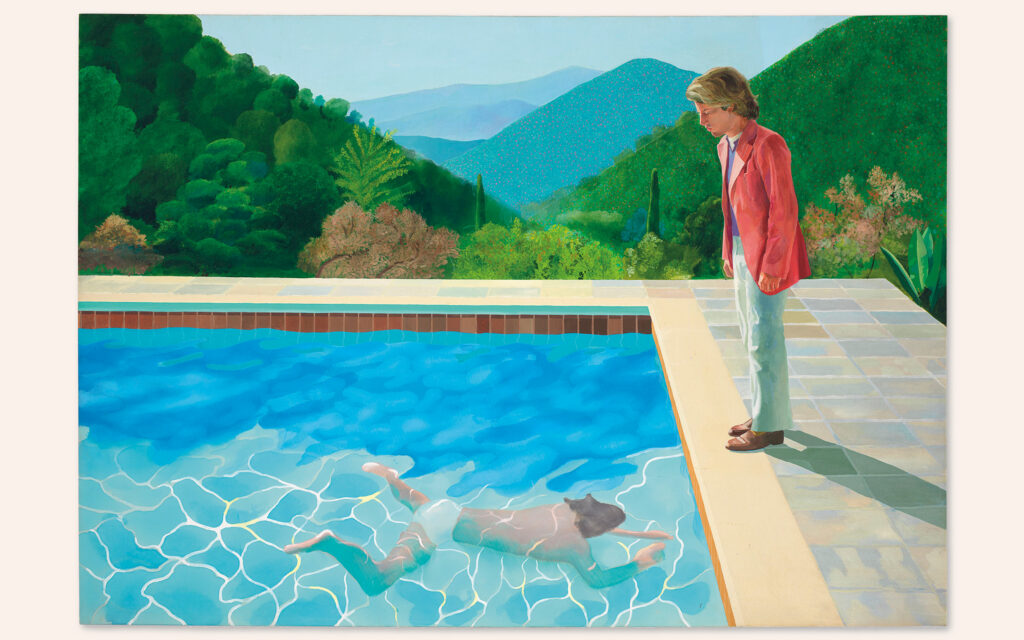
Hockney’s market was already firmly established during his lifetime. His Portrait of an Artist (Pool With Two Figures) sold for $90.3 million at Christie’s in 2018, setting a record price for a work by a living artist at the time.

His death has naturally prompted renewed attention. MyArtBroker reported increased interest in Hockney editions following news of his death, while The Art Newspaper reported that his work was prominent at Art Basel shortly afterwards.
That activity should not automatically be interpreted as evidence that every Hockney work will increase in value. The market is considerably more complicated than that.
Instead, it illustrates how an artist’s transition from living creator to historical figure can change the way collectors view their work.
There is also an important distinction between being famous and being historically significant. Fame can attract attention, but longevity, influence, institutional recognition and the survival of a significant body of work can give an artist a much deeper position within the cultural record.
The value that cannot be put on a price tag
Perhaps this is what makes art different from many other alternative assets. A rare whisky can be valuable because of its age, scarcity and provenance. A precious stone can derive value from rarity, quality and demand. Art can have those characteristics too, but it can also carry meaning.
It can show us what people valued, how they lived, what they believed and how society was changing.
That doesn’t make every historically interesting artwork a successful investment, and it certainly doesn’t remove the financial risks involved in buying and selling art. But it does help explain why certain works continue to attract collectors long after they were created.
The most enduring pieces of art can become more than possessions. They become evidence of a particular time, preserved through the perspective of the person who created them.
David Hockney’s career is a particularly vivid example. His work moved from 1960s Britain to California, from traditional printmaking to photography and digital technology, while continuing to engage with the world around him.
Perhaps, then, the most interesting question for collectors is not simply “What will this be worth?”, It is “Why will this still matter in 50 years?”. For genuinely significant works of art, the answer to that question may ultimately be just as important.
References
- The Guardian – David Hockney, pioneering British artist famed for his pools and portraits, dies aged 88
- This Is Money – Can David Hockney prints make you a mint? Artist’s death sparks revival of his work – here’s what investors need to know
- MyArtBroker – How To Invest In Art in 2026
- Business Insider – Art Investment: Wealthy Buyers, Paintings, Luxury Auctions and Investing